
FCRTA School-Based Microgrid Feasibility Study (Phase 2)
Powering Electric Fleets.
Strengthening Fresno County Schools and Communities
WHAT IS FCRTA STUDYING?
The Fresno County Rural Transit Agency (FCRTA) provides public transportation services to rural communities throughout Fresno County. As part of its efforts to transition to zero-emission vehicles and improve transportation infrastructure, FCRTA completed its initial Microgrid and Multimodal Resiliency Hub Feasibility Study in 2024. Building on that work, FCRTA is undertaking a second phase of the Study, funded through a California Department of Transportation (Caltrans) planning grant, to evaluate opportunities for microgrid development at public school district properties.
FCRTA is seeking partnerships with public school districts across Fresno County to explore opportunities for shared fleet EV charging and microgrid infrastructure. The Study will evaluate whether school properties can support solar generation, battery storage, and electric vehicle charging serving both school district and FCRTA electric fleets, while potentially providing backup power and other resilience benefits to participating campuses and surrounding communities.
WHAT IS A MICROGRID?
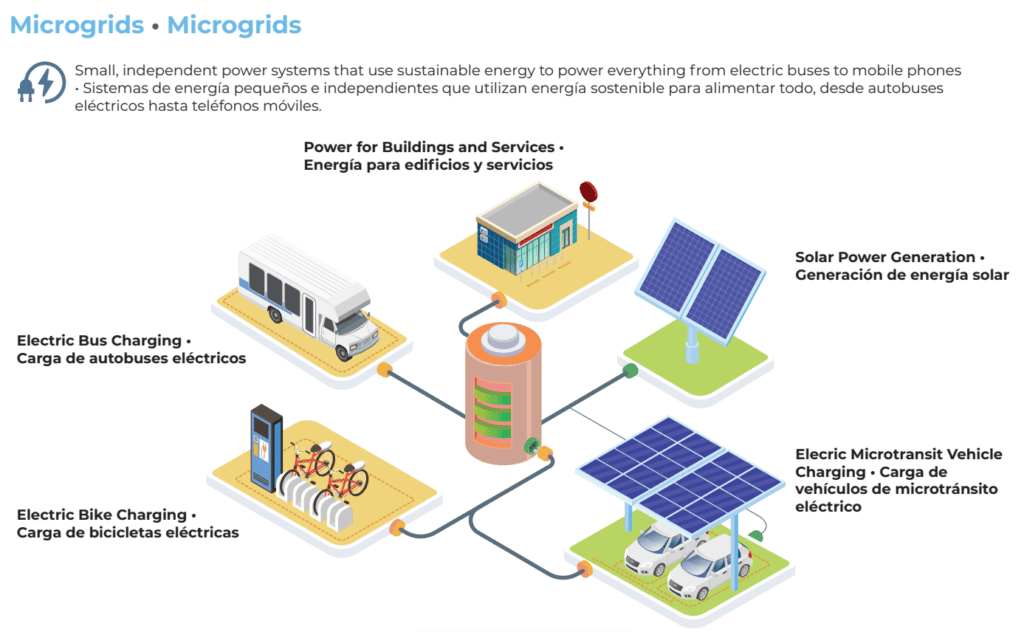
A microgrid combines local energy resources, such as solar generation and battery storage, with controls that manage how energy is produced, stored, and used. A microgrid typically remains connected to the utility grid and, depending on its design, may support designated critical energy loads during a grid outage.
DOWNLOAD THE MICROGRID STUDY FACTSHEET HERE
WHY SCHOOL SITES?
California law requires newly purchased or contracted school buses to be zero-emission beginning in 2035.[1] Similarly, California's Innovative Clean Transit (ICT) regulation requires transit agencies to transition toward zero-emission bus fleets, with all new bus purchases required to be zero-emission beginning in 2029.[2] These complementary requirements create an opportunity for school districts and FCRTA to coordinate investments in shared charging infrastructure. School campuses may also offer space for solar generation, battery storage, and facilities that can support community resilience during emergencies or outages.
[1] https://law.justia.com/codes/california/code-edc/title-1/division-1/part-10-8/section-17927/
2 https://ww2.arb.ca.gov/innovative-clean-transit-regulation-summary
COMMITTEE PRESENTATIONS
The Advisory Committee will meet five times during this study. The presentation material will be posted here after the meetings.
Meeting #1
- Presentation
Meeting #2
- Presentation
Meeting #3
- Presentation
Meeting #4
- Presentation
Meeting #5
- Presentation
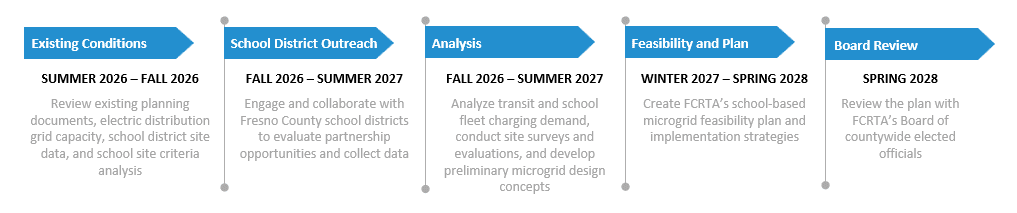
STUDY TIMELINE
CONTACT THE PROJECT TEAM
Chrissy Mancini Nichols, Project Manager, Walker Consultants
CMancini@walkerconsultants.com
Nick Auerbach, Deputy Project Manager, Walker Consultants
NAuerbach@walkerconsultants.com
Funding for this Study is provided by a Grant from the California Department of Transportation (Caltrans).